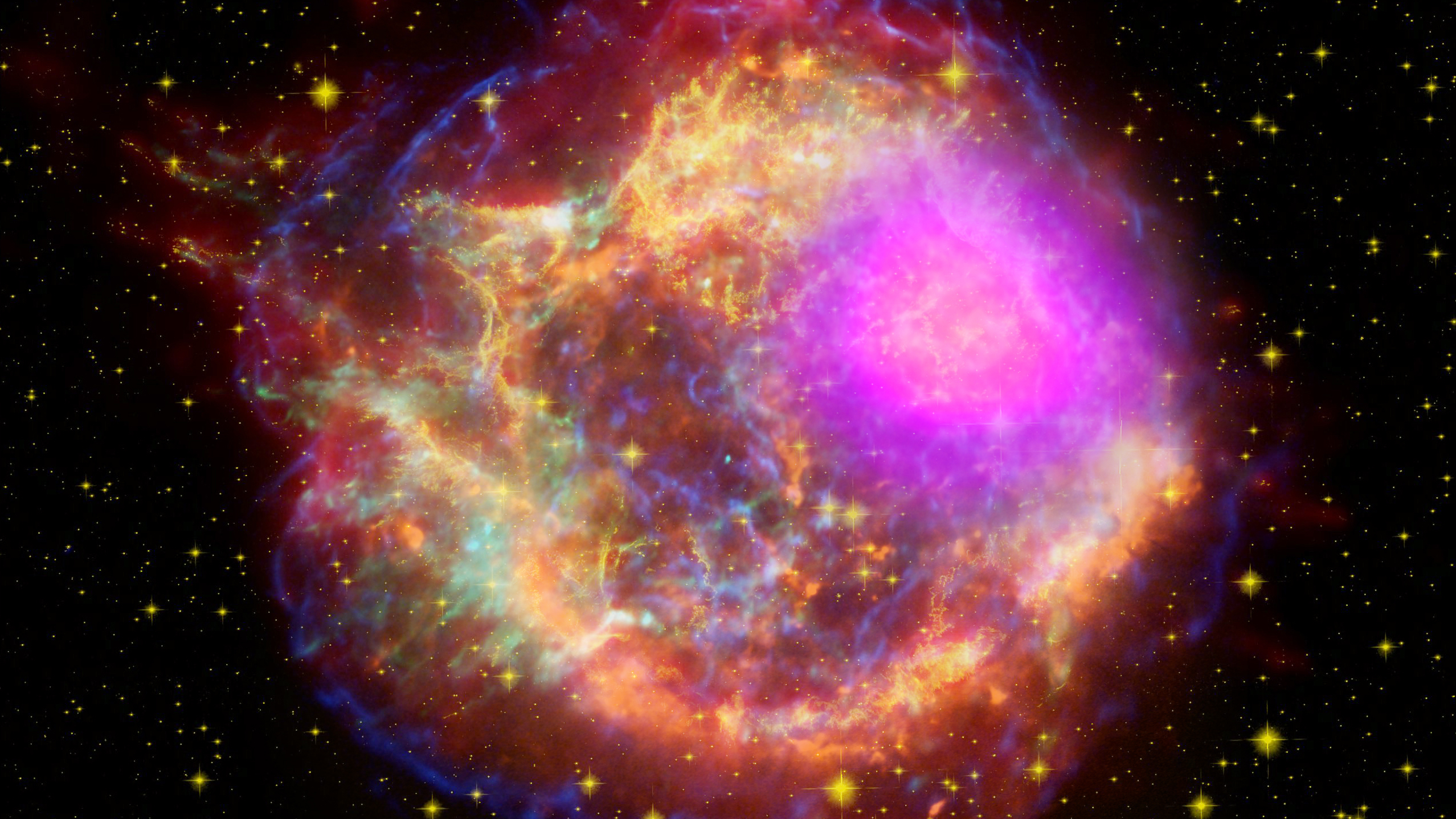
A Nova Explosion, a dazzling event in the cosmos, has fascinated astronomers and stargazers for centuries. This phenomenon, often mistaken for supernovae, has distinct characteristics and an intriguing scientific background. In this article, we will delve into the science behind a nova explosion, exploring its causes, types, and significance in the universe.
What is a Nova?
A nova is a powerful and sudden brightening of a star, which can increase its luminosity by a factor of several thousand to over a million. The term “nova” is derived from the Latin word for “new,” as these explosions can make a star appear like a new star in the sky. Unlike supernovae, which signify the death of a star, a nova involves a white dwarf star in a binary system and is a recurrent event.
The Mechanics of a Nova Explosion
- Binary Star System: A nova occurs in a binary star system, where two stars orbit each other closely. Typically, this involves a white dwarf and a companion star, often a red giant.
- Mass Transfer: The white dwarf, with its intense gravitational pull, siphons hydrogen-rich material from its companion star. This material accumulates on the white dwarf’s surface, forming a dense, hot layer.
- Nuclear Fusion: As the hydrogen layer builds up, it reaches critical pressure and temperature. This triggers runaway nuclear fusion on the white dwarf’s surface, causing a dramatic increase in brightness—this is the nova explosion.
Types of Novae
- Classical Novae: These are the most common type, resulting from the mass transfer process described above. They can recur over periods ranging from several decades to centuries.
- Recurrent Novae: These novae occur in systems where the mass transfer rate is higher, leading to more frequent explosions, sometimes as short as a few decades apart.
- Dwarf Novae: These are smaller and less intense than classical novae, often resulting from instabilities in the accretion disk around the white dwarf.
Observing Nova Explosions
Novae can be observed with telescopes, and some are visible to the naked eye. The sudden increase in brightness can last from a few days to several months before gradually fading. Astronomers monitor novae to study their behavior and gather data on the processes involved.
Scientific Significance of Novae
- Element Creation: Novae contribute to the chemical enrichment of the galaxy. The explosions eject material into space, spreading elements like carbon, nitrogen, and oxygen.
- Stellar Evolution: Studying novae helps scientists understand the life cycles of stars, particularly in binary systems. It provides insights into the behavior and fate of white dwarfs.
- Distance Measurement: Novae can serve as “standard candles” for measuring astronomical distances, contributing to our understanding of the scale of the universe.
Recent Discoveries and Research
Advancements in technology have allowed astronomers to observe novae in greater detail. Space telescopes and ground-based observatories have provided high-resolution images and spectra of nova explosions. These observations help refine theoretical models and improve our understanding of the underlying physics.
Conclusion
The science behind a nova explosion is a captivating topic that bridges stellar evolution, nuclear physics, and cosmic chemistry. These powerful events not only light up our night skies but also play a crucial role in the ongoing processes of the universe. As research continues, we can expect to uncover even more about these fascinating celestial phenomena.